Re-Claiming Our Political Culture

Sunday, July 23, 2006

Governing with values vs governing with interests

Governing with values vs governing with interests

A government can either govern its internal and foreign affairs with values or interests. Sadly in today’s world, governments lack values and they instead govern solely with interests. However the pursuit of interests is detrimental because it can go against one’s own values during which they are highly likely to compromise on their values to uphold their interests.

An American senator once said America has no friends, only interests. Today that has become true of every North American and European nation which are the only nations in the globe that proudly announce and proclaim as upholders and guardians of universal values such as justice and human rights. Not only do they have no friends, they have no (real) values either since they are willing to comprise on their values should it conflict with their interests.

Today North America and Europe stands behind Israel’s attrocities because it is in their interests to do so. The Zionist lobby within these regions are strong and influential because of the large influence Zionist corporations have in these western economies. These Zionist corporations leverage on the economic hegemony that they have in the western economies to establish political hegemony on the western nations’ foreign policies. Even though the atrocities of Israel runs counter to international law, basic human rights, regional peace, stability and security, Western nations are economically and politically hijacked to support Israel. As Mahathir not too long ago said “Jews rule the world by proxy” well he was actually implying “Zionists rule the world by proxy”.

We can see similar examples of how countries which manage to gain economic influence in Western nations are able use it to gain political influence. India in yester years had its nuclear program under much scrutiny and its refusal to sign the non-proliferation treaty earned nothing but criticisms. Today as India is an economic giant, offering wealth of opportunities for Western nations, India has been able to use this neuve economic influence to gain political influence for its nuclear program. The same can be said of China, etc.

Should the world be governed by interests and not values, then universal values that protect mankind such as justice, human rights, equality etc will break down as how they have today. Values never change. What is a value today will be a value tomorrow. Only people decide whether or not to adopt it. However interests change. What is not an interest today can be one tomorrow and what is an interest today can otherwise tomorrow. Should leaders build a world on such basis then instability and lack of security will be its hallmark. Interestingly the challenges that the pursuit of interests in governance will bring about can only be resolved with values. So someday the world will be forced to return to values and base its interests on values.

Friday, July 21, 2006

European Governments' Benign Support For Israeli Action


One need not second guess what is the stand of European governments in this Lebanon-Palestine crisis. Its clearly evident that the European nations are benignly supporting Israel. They have so far been clear, loud and explicit in their denounciation of Hezbullah and they are making every efforts to stop Hezbullah. However they have been chewing their words for Israel and showing absolutely no intention to stop Israel. What is equally clear is that the Europeans are waiting for Israel to finish its delibrate and categorical massacre of Lebanese and Palestinians before intervening during which they will pretend to hold high regard for human rights abuses or war crimes. So much for the values of Europeans. When the "civilized man" starts supporting the barbarous man, then he is nothing less than a barbarian himself.

Thursday, July 20, 2006

Singaporeans In Solidarity With Palestine & Lebanon


STOP THE KILLING OF WOMEN,
STOP THE KILLING OF CHILDREN,
STOP THE KILLING OF CIVILIANS,
STOP ISRAELI AGGRESSION
SINGAPOREANS IN SOLIDARITY WITH PALESTINE & LEBANON

Tuesday, June 20, 2006

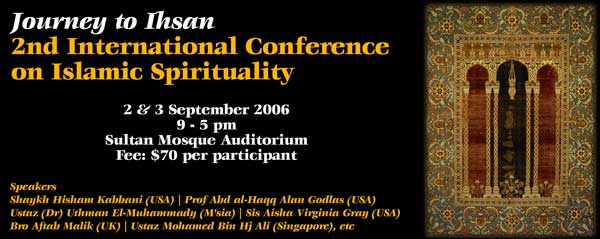
2nd International Conference on Islamic Spirituality

2nd International Conference on Islamic Spirituality


A good departure from the typical conferences held here in Singapore which tirelessly dwell upon contemporary discussions.

For the typical contemporary topics, the Muslim audience get to hear what they like to hear and it tends to be largely popular. But contemporary topics tend to be chiefly subjective which can be discussed till eternity without seeing an end or change. Likewise you cant see quite an observable impact or difference on the audience as they bring back little that which can truely enrich their lives.

In traditional topics like above, the audience can get to hear what is useful, resourceful, beneficial and helpful for them to hear where they can bring back something strong and useful which they can individually and privately work on.

A must go................... for info click ................ here

Tuesday, June 13, 2006

US 'biggest global peace threat'

The biggest irony of Bush and Blair's war in iraq to bring freedom to iraqi people and safety to the world has been to bring about the very opposite results.

US 'biggest global peace threat'

People in European and Muslim countries see US policy in Iraq as a bigger threat to world peace than Iran's nuclear programme, a survey has shown. The survey by the Pew Research Group also found support for US President George W Bush and his "war on terror" had dropped dramatically worldwide.

Goodwill created by US aid for nations hit by the 2004 tsunami had also faded since last year, the survey found.
The survey questioned 17,000 people in 15 countries, including the US. The latest in a series of annual polls by the Pew Global Attitudes Project interviewed respondents between 31 March and 14 May 2006. Its release coincides with a surprise visit by President George W Bush to Baghdad in an effort to shore up support for US policy in the region.

'Fading goodwill' The latest survey shows the worldwide reputation of the US continues to suffer over its prosecution of the "war on terror". Sharp declines in the public perception of the US were particularly apparent in India, Spain and Turkey. Goodwill towards the US had fallen from 71% to 56% in India, from 41% to 23% in Spain and from 23% to 12% in Turkey.

A majority of people in 10 of the 14 countries outside the US surveyed said the war in Iraq had made the world a more dangerous place. Some 60% of people in the UK, which is the US biggest ally, felt the Iraq war had made the world less secure, while some 30% said it had made the world safer.

According to the survey: Worldwide support for the "war on terror" has remained the same or declined European confidence in Mr Bush has sunk even lower than it was last year A majority of people in most countries feel the US will not achieve its goals in the "war on terror" The survey also found little remaining evidence of the goodwill the US had earned over its aid for victims of the 2004 Indian Ocean tsunami.

In Indonesia, a major recipient of US tsunami aid, favourable opinions of the US had fallen from 38% in 2005 to 30% this year. "Last year we saw some good news in countries like Russia and India," Andrew Kohut, director of the Pew Research Centre, told the Associated Press news agency. "That good news being wiped away is a measure of how difficult a problem this is for the United States."

Muslim differences According to the survey, people in the US and Europe have grown increasingly concerned in the last year over Iran's nuclear programme. The US has accused Iran of seeking to build a nuclear bomb - but Iran says its nuclear programme has a purely civilian objective. Almost half of the Americans surveyed, 46%, viewed the current government in Iran as a "great danger" to stability in the Middle East and to world peace - a figure that has risen from 26% in 2003.

In Germany, Spain, France and the UK, the percentage of people who regard Iran as a great danger is roughly three times greater than it was three years ago. However, the poll showed public opinion in predominantly Muslim countries was far less troubled by Tehran's nuclear programme.

Muslim people also appeared less concerned than Europeans and Americans by the victory of the Hamas militant group in Palestinian elections earlier this year. The survey found concern over bird flu was largely confined to Asia, while two-thirds of people surveyed in each country said they were worried by global warming. Concern over the greenhouse effect was highest in India and Japan and lowest in the US and China.

The survey interviewed people in China, Egypt, France, Germany, Great Britain, India, Indonesia, Japan, Jordan, Nigeria, Pakistan, Russia, Spain, Turkey and the US. Its margin of error was two to six percentage points. Story from BBC NEWS:http://news.bbc.co.uk/go/pr/fr/-/2/hi/americas/5077984.stmPublished: 2006/06/14 05:44:48 GMT

Tuesday, May 23, 2006

Burma remains ASEAN’s weakest link— Farish A Noor

Burma remains ASEAN’s weakest link— Farish A Noor

Following the nationalisation of the Burmese private sector in the 1960s that led to the so-called “12 economic sectors”, there has emerged a 13th: corruption. It remains unchecked till today


Since early this year the level of violence in the south-eastern regions of Burma has been escalating. The Burmese army remains caught in a bloody counter-insurgency conflict with the KNU (Karen National Union), the armed wing of the Karen autonomy movement that purports to represent the minority Karen community whose homeland lies in Burma and borders neighbouring Thailand.


Already thousands of Karens have been forced to flee into Thailand, straining Thai-Burmese relations that have hardly been rosy in the first place. Burma’s numerous insurgencies have thus become the problem of Thailand, and by extension ASEAN as well.


The Association of Southeast Asian Nations (ASEAN) remains one of the more successful models of international cooperation and regional bloc-building in the world today. Compared to the European Union (EU) ASEAN cannot be said to be a union of any sort: vast disparities of wealth and power remain within the assembly of 10 nation-states and despite talk to the contrary ASEAN remains at odds with itself as some of the bigger ASEAN powers — notably Indonesia — continue to play the role of “big brother” watching over the junior members.


Notwithstanding ASEAN’s failure to develop anything resembling a common economic and trading bloc, it remains successful in the sense that it has managed to maintain relatively good relations among its members and ensured that at the height of the Cold War it stayed neutral, albeit neutral on the side of the West. ASEAN’s greatest moment came with the fall of Vietnam, and the rest of Indochina, following the US defeat in 1975. The world, fearing the worst, turned the other way and predicted an “inevitable” collapse of Southeast Asia that would then be devoured by the Soviet bloc.


Despite the negative prognosis, ASEAN’s original founding states — Thailand, Malaysia, Singapore, Indonesia and the Philippines — cobbled together a loose coalition based purely on pragmatism and the need to survive. By supporting each other the member states not only managed to weather the storms of the Cold War era but also engineered their own economic miracle in the 1980s with the help of foreign (notably Japanese) direct foreign investment. In the post-Cold War era, ASEAN’s greatest success has come in the form of its gradual expansion to include countries like Brunei, Cambodia, Laos and Vietnam. After all the bombs and troops the US sent, it was ASEAN that finally brokered the peace in Indochina and helped bring about the global acceptance and rehabilitation of Vietnam.


There remains, however, one major stumbling block: Burma. Burma closed its doors to the world following the army coup led by General Ne Win in 1963. Since then the country has become a hermit’s kingdom that was once guided by the left-leaning military regime’s ideology, dubbed the “Burmese way to Socialism”. The net result was more than three decades of isolationism, rampant abuse of human rights by the army, the marginalisation of ethnic minority groups, total news blackout and the stagnation of the economy. Following the nationalisation of the Burmese private sector in the 1960s that led to the so-called “12 economic sectors”, there has emerged a 13th: corruption. It remains unchecked till today.


ASEAN is at pains to show the world that it can deal with the Burmese problem on its own terms. Thus far it has little to show for its efforts. Last month Malaysia’s Foreign Minister Syed Hamid Albar cut short his visit to the country after it became evident that the military junta has done little to improve its record of governance and that all the talk of Burmese human rights commission etc was mere eyewash. Following the denial of his request to visit representatives of the country’s opposition such as Aung San Su Kyi, Minister Albar returned to Malaysia, with the news that nothing has changed.


The news about the military campaign against the Karen minority in the region bordering Thailand is therefore serious for those who have been working hard to limit the excesses of the Burmese junta and to talk sense to the generals in charge. With increasing pressure being brought to bear by international bodies and NGOs such as the United Nations and Human Rights Watch, the Western powers seem to be growing less and less patient with ASEAN’s failure to deliver results. Ironically it is ASEAN’s slow and cautious approach towards integration, that helped bring Vietnam back into the fold, may undo the situation for good in the case of Burma. While Burma can count on its relative strategic insignificance to ensure that it will not become a military target for the USA, it has indeed become a point of embarrassment for the rest of ASEAN and the stick to beat it with.

Dr Farish A Noor is a Malaysian political scientist and human rights activist, based at the Zentrum Moderner Orient (ZMO), Berlin

Monday, May 22, 2006

Soeharto gets away with it — Farish A Noor

Saturday, May 20, 2006

VIEW: Soeharto gets away with it — Farish A Noor

Guided by the best of naïve intentions yet blinded by Soeharto’s own militarist and authoritarian values, he will probably pass his life as yet another casualty and mistake of the 20th century: the failed Asian dictator whose dreams of glory for his country were nonetheless paid for by the blood of his countrymenThe news that former Indonesian president Soeharto is now deemed “unfit” to stand trial for abuse of power in Indonesia has hardly come as a surprise to those who know the country well.


Few really believed that the man who had ruled Indonesia for three decades (from 1966 to 1998) could be brought to trial and sent to jail. The issue, however, is not that the man “got away with it”, but rather what this bodes for the future of Indonesia.Despite the euphoria that greeted the fall of the Soeharto regime and the hope that the country would finally make the transition to a working democracy of sorts, there remain problems that still deny the country and its people the dignity they deserve.


Indonesia remains a country on the verge of collapse, the great giant of Southeast Asia which increasingly looks like the sick man of the region; whose frail condition is matched only by the frailty of decrepit neighbours, Thailand and the Philippines.That the former president has been allowed to slip away is understandable considering how the military elite of the Soeharto era have managed to preserve themselves.


The country’s current president, Bambang Susilo Yudhoyono, is likewise a former general, trained by the Americans. He too is in the good books of Washington for his willing complicity in the US-led “global war on terror”. Yudhoyono was also part of the Soeharto regime. Indeed he served his president very well till almost the end, when he tactically allowed himself to be sidelined just before the pro-democracy movement took to the streets in mid-1998 following the East Asian economic crisis.


Well placed, deeply embedded yet marginal enough to be spared the wrath of the public, he has managed to carve a place for himself in the convoluted and messy political terrain of post-Soeharto Indonesia.Other generals and aides to Soeharto have also managed to inch their way back into the country’s Byzantine corridors of power. Notable among the old stalwarts was General Hendropriyono, once dubbed the “butcher of Lampung” for his part in the bloody suppression of the Islamist movement in Lampung, South Sumatra. Just when other Indonesian officers — like Generals Wiranto and Moerdani — were being dragged to court for their part in the atrocities in East Timor, Hendropriyono found himself saved by the events following September 11, 2001.


He was put in charge of anti-terrorism operations by none other than Megawati Sukarnoputri, the former president. Indonesian human rights groups were aghast at Megawati’s decision that betrayed a total neglect of local sensibilities and an all too evident desire to cosy up to Washington.Now that most of the old military and business elite are back in power, it would seem that the time is right to absolve Soeharto for the ills and mistakes of his period in power. His defenders and supporters claim that he was in many ways a visionary, a man who took Indonesia from a dependent import-substitution economy to the status of an emerging “Asian Tiger” economy in the space of two decades.


Soeharto’s defenders are certainly not wrong here: Indonesia is a model of successful nation-building against impossible odds. In an archipelago made up of 14,000 islands it is a country where literacy is almost universal and where even in the most remote island or village there are post offices, clinics, schools, roads and communication facilities. The state-controlled media reaches out to every citizen. Indonesia’s painful birth amid an anti-colonial struggle and several subsequent civil wars persuaded many that like some former colonies in Africa it would be a failed state.


Yet that did not happen.But along with the laying down of the infrastructure for nation-building came the centralising logic of a maximalist state at the hands of a military elite whose understanding of democracy, civic and civil participation and popular representation remained rudimentary. By the time of political reforms of the 1970s Indonesia had become a thoroughly depoliticised state.


Its economy grew thanks to the influx of foreign capital (much of it Japanese and American) and thanks to the structural adjustment policies formed by Soeharto’s handpicked “Berkeley mafia” led by men like the German- and American-trained BJ Habiebie. Thus Indonesia’s economic takeoff was not without its own costs — most notably in the loss of political rights, press freedom and fundamental liberties.Soeharto was also one of the most vocal exponents of what was then known as the “Asian values” school, led by Lee Kuan Yew of Singapore that argued that in Asia economic rights should come before political ones.


It was in this depoliticisation process that Indonesia found wealth but lost its soul. The violent annexation of East Timor in 1974 showed that this former colony could itself become a colonising power and impose the same colonial logic on other societies and states. The suppression of the people’s movement in East Timor remained and shall remain a blight on Indonesia’s record. Central to this crisis were Soeharto and his generals, who masterminded the annexation and the policies of pacification and resettlement that followed.


In this respect Soeharto was not merely a dictator in his own country but also a coloniser of others.Linked to the shameful conduct of Soeharto and his cronies is the equally shameful conduct of the more powerful Western states — notably the USA, Australia and Britain — who aided and abetted the Soeharto regime during the worst years of military rule and violent authoritarian government. America’s role in propping up Soeharto and promoting Indonesia as the “bulwark” against Communism in Asia ended only with the culmination of the Cold War in the West.


This reduced Southeast Asia to a mere sideshow of little import. Yet in this eastern corner of the world millions of lives were lost thanks to the realpolitik considerations of technocrats and ideologues in Washington who were prepared to turn a blind eye to Soeharto’s excesses as long as he stayed “neutral on the side of the West” — like Ferdinand Marcos.One can only wonder what Soeharto’s final fate will be. Marcos and the Shah of Iran were spirited away as their tattered empires fell about their feet, only to die lonely deaths in exile and shame.


Soeharto, the fervent nationalist and patriot till the end, will probably die in his own country surrounded by his countrymen whom he led and oppressed. Guided by the best of naive intentions yet blinded by his own militarist and authoritarian values, he will probably pass his life as yet another casualty and mistake of the 20th century: the failed Asian dictator whose dreams of glory for his country were nonetheless paid for by the blood of his countrymen.Dr Farish A Noor is a Malaysian political scientist and human rights activist, based at the Zentrum Moderner Orient (ZMO), Berlin